Wednesday, March 30, 2016

Reverse Engineering Due Dates

  • March 18th: Introduction of the project/PowerPoint presentation (Engineering)
  • April 1st: Product approval sheet due (Engineering)
  • April 4th: Introduction to the Human Connection (Biology)
  • April 8th: Research in the Media Center (Biology)
  • April 13th & 15th: Field Trip to the Worcester Art Museum/In Class Product Activity (Math)
  • April 12th & 14th: Technical writing completed with rough draft attached (English)
  • April 25th & 26th: Research in the media center (History)
  • April 25th-29th: ALL DAY ENGINEERING SCHEDULE AND ENGINEERING EXTRA HELP AFTER SCHOOL
  • April 27th: Research for the history timeline must be completed (History)
  • April 29th: Inventor files and working drawings printed (Engineering)
  • May 4th: Timeline completed (History)
  • May 10th: The Human Connection Completed (Biology)
  • May 13th: Surface Area and volume for product completed (Math)
  • May 17th: Poster board completed for Learning Fair (Engineering)
  • May 18th: Learning Fair


     IMPORTANT: ALL LATE WORK MUST BE BROUGHT PERSONALLY BY THE STUDENT TO THE TEACHER THAT ASSIGNED IT BY MAY 17th. OTHERWISE YOU WILL BE INELIGIBLE FOR THE LEARNING FAIR. 

Tuesday, March 29, 2016

Reverse Engineering Project

     The ETA's next cross-curriculum project will based around reverse engineering. Students will have to research and reverse engineer a product with a minimum of five pieces. They will need to detail the history, function, design, and how this product is used by the human body. Students will use technical writing, graphics, and Inventor to complete the project.
Each Student Will:
  1. Research an existing existing technology/product
  2. Complete and submit the "product approval sheet" in Engineering
  3. Submit a list of dates of their technology/product and world events timeline in History
  4. Submit a paper demonstrating technical writing of their technology/product in English
  5. Complete a graphic organizer on how how the technology/product impacts human anatomy in Biology
  6. Compute the surface area and volume of the technology/product in Algebra/Geometry
  7. Complete and submit Inventor files and working drawings in Engineering
  8. Display their work on a poster board in a aesthetically pleasing design
     If students want to, they can attend the learning fair on May 18th for extra credit.

Friday, January 22, 2016

Slater Mill, Pawtucket RI

Ranger Chuck Arning and World History teacher Jesse Garcia presented a slide show that highlighted the lives of workers in the Industrial Revolution. The slide show was a precursor to a field trip to the Slater Mill in Rhode Island.


Students watching the slideshow
With the help of the National Parks Services, rangers and museum guides presented a movie highlighting industrial life along the Blackstone Canal. Students were then led through two museums; Wilkinson Machine and Slater Mill. Students walked along the Blackstone Canal, observing water control methods that powered the factories. Finally, students traced the Blackstone Canal from Worcester to Providence on a giant floor map in the visitor's center.

A side view of Slater Mill

Students said:
  • "We took a tour of the former mill and a house that Samuel Slater once stayed in." 
  • "We looked at all [the] machines and buildings at Slater Mill." 
  • "We learned more about the Industrial Revolution."
  • "We looked at the mills, and watched a movie of Slater Mill before and after."
  • "We toured Slater Mill and learned about its functions."
  • "We walked around the first factory in Rhode Island." 
  • "We saw old mills and a presentation." 
  • "We followed guides and they explained how certain things are historical."
Students looking at a piece of machinery
What they learned: 
  • "...how they made cotton."
  • "How [the workers'] food was prepared."
  • "How bad of a living [people] had."
  • "How long the canal was."
  • "One water wheel powered all the machines."
  • "Houses were jammed with people."
  • "How cotton was packaged and shipped and transported."
  • "How cotton was made into thread."
  • "How young kids were when they started working in the factories."
  • "How young [people] died."
  • "People who worked in mills got more money."
  • "The Industrial Revolution promoted slavery." 

Wednesday, January 13, 2016

Learning Fair 2015

December 16th, 2015 was the ETA's 7th annual Blackstone Canal Learning Fair. It was a resounding success. The evening opened with three students, Daria Soto, Kyle Monfredo, and Nicole Canizares. They spoke about the project, highlighting the process, stressing the importance of organization, and what the field trips added to the experience. All three students did a great job presenting.
The student speakers
Mr.Garcia opening the night
Mr. Garcia explained the process for documenting the dialogue between participants and guests, with raffle cards. Students and guests autographed each others raffle cards after each interaction, and once a card was filled they entered their card into the raffle box and they could get another one.

Parents and teachers looking around
A view of the canal
Parents and guests then had an opportunity to view the work from all students. The students' models were arranged in the center of the room as a recreation of a possible future for the canal district. Teachers, administrators and other school staff mingled with parents, learning about the engineering process, and the once and future canal. At the end of the learning fair, a student raffle card and a guest raffle card were drawn by a brave volunteer to award a gift certificate to Barnes and Nobles.

The brave volunteer
Students reported the next morning that the night went better than they could've expected and they were eager to receive their extra credit.

The freshmen ETA teachers, who worked just hard as the students.
A big thank you to them!

Tuesday, December 15, 2015

Bringing Back the Blackstone

Blackstone Canal

Engineering and Technology Academy Invites You!

The ETA, in conjunction with the National Parks Service, are holding their 7th annual “Bringing Back the Blackstone” project fair, and welcome the community to see. Those who attend will have the freedom to walk around and talk to the students, parents, and staff about the projects and the future of the Canal District, in a casual environment. Snacks and drinks will be provided.  

Time: 6:30-7:30 pm.
Location: In the cafeteria of Doherty Memorial High School

Monday, December 7, 2015

Kelly House, Lincoln/Cumberland, RI


Ranger Chuck Arning presenting a slide show on life in the mill village in the classroom
On October 7th, Ranger Chuck Arning spent the morning at Doherty High School to explain the many different lifestyles of the people in the Industrial Revolution. This slide show contained historic photos, primary sources, and quotes from this time period in New England. Students used this opportunity to ask questions and prepare themselves for their next field trip. The National Park Services has been an invaluable partner to support teachers and students with the Blackstone Cross-Curriculum Project. 


On October 8th, students from the ETA went to Kelly House. Kelly House is the site where the Kelly Mill and village once stood. Students explored the mill owner's house, which has been converted into a museum, detailing the evolution of factories and industrial life. Students walked along the canal, analyzing the challenge of effective water control. Students designed and presented solutions for better management of the Blackstone River. Finally, students learned how the workers lived in the village next to the factory. This field trip was made possible by the funding from the National Park Foundation "Ticket To Ride" Program. 

Ranger Chuck Arning helping students connect history and engineering.
The National Parks Service worked as a team with the staff from the Kelly House Museum to help students understand life and technology during the Industrial Revolution. The students applied this knowledge to their Blackstone Canal projects. 


This what students said about the trip:
  • "We [took] a tour of of what was left from the Industrial Revolution..."
  • "We walked around and saw the factory."  
  • "I learned about the history of the place and how everything worked." 
  • "On this field trip we went to a mill and saw what they did and what the canal was used for."
  •  "On this field trip we learned about how factories worked and about how they received power." 
  •  "On the field trip, we took a tour of the Kelly House and tried to find a way to fix water distribution."
  •  "We walked around the mill area, discussed our plans to control the canal water, and had a mini tour of the Kelly House."
  • "We took a look at the old mills and canal..." 
  • "...we learned where the old mills where with a map..."
  • "...we saw what [the factories] looked like years ago..."

The students had this to say about what they learned:
  • "The Blackstone Canal created mill villages."
  • "The bell controlled what time people got up."
  • "Mill owners controlled the people."
  • "We saw a figure of Captain Kelly."*
  • "...about mills around the Blackstone River..."
  • "...about the living conditions of people in the mill village..."
  • "The factory is used as a residential area now."
  • "How the canal trade port works."
  • "How long it took to get from Worcester to Rhode Island."


* Captain Kelly was the owner of the Kelly mill at one time.

Friday, December 4, 2015

Riverbend Farm, Uxbridge, MA

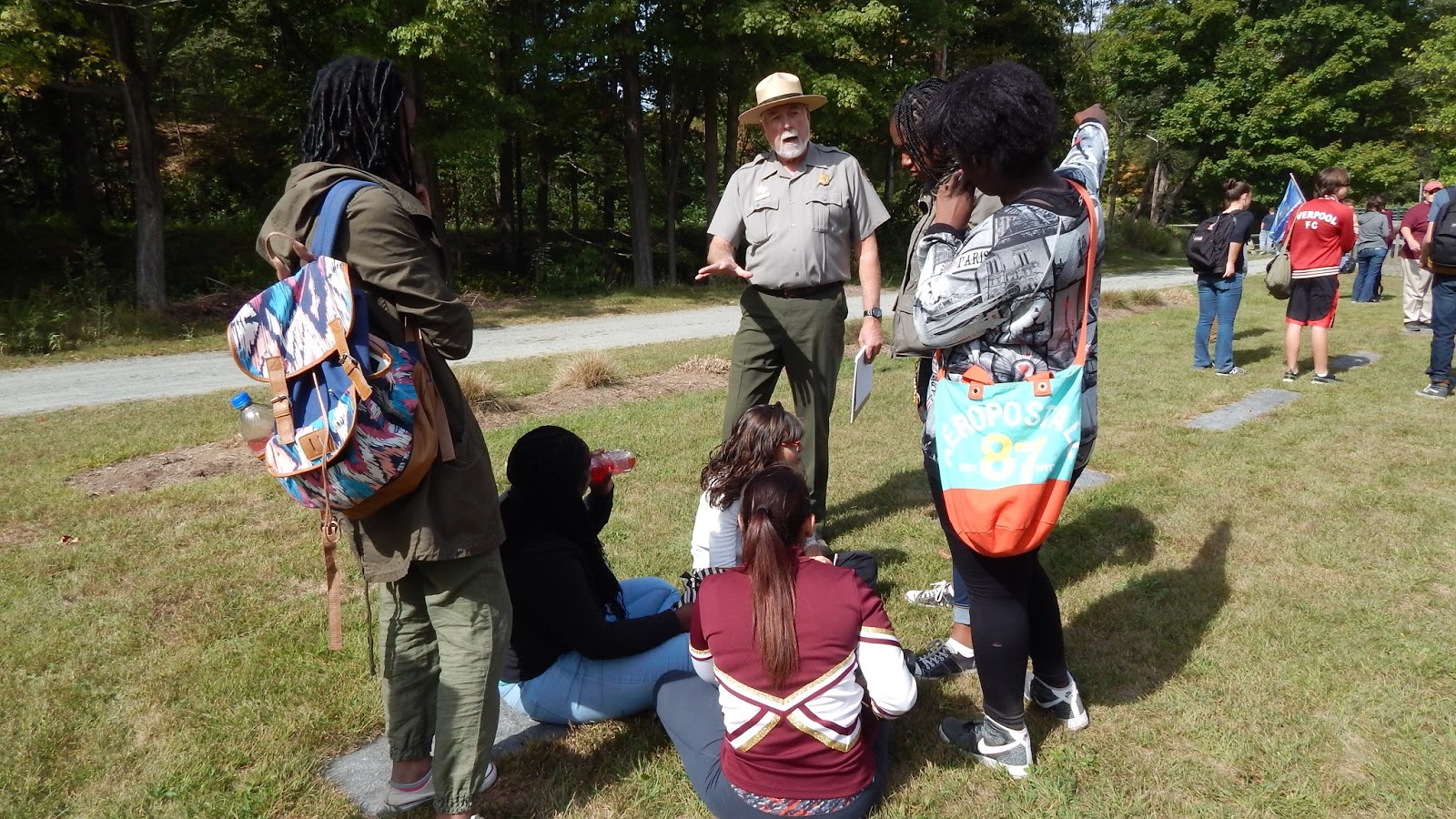
Students from Doherty Memorial High School in the Engineering and Technology Academy visited Riverbend Farm on September 25th, to learn about the Blackstone Canal and canal locks. The trip specifically highlighted the challenges to controlling water for power as well as some solutions. Finally students, in cooperative learning groups, designed and presented a proposal for the future bike path to be constructed in the area. This was an opportunity for students to understand the impact the Blackstone Canal had on the area, and how much impact their hypothetical new canal would too. This field trip was made possible by the funding from the National Park Foundation "Ticket To Ride" Program. 


This is how the students described the field trip:
  • "...we had to figure out a map using contour lines..." 
  • "...we saw how much things have changed over time."
  • "We walked through the woods learning about transportation and lifestyle in the Industrial Revolution." 
  • "...we made a map for a new bike trail..." 
  • "On the field trip, I learned about the function of the canal and the area of land around the farm."
  • "...we thought up bike paths and presented our ideas." 
  • "On the field trip we had to figure out a bike path on a map using contour lines, also we hiked up 'Goat Hill' and saw the canals and a bit about the history of the hill..."

    When asked, they said they learned/experienced:
    • "I learned how they split rock."
    • "How rock was shaped."
    • "[People] used the [Blackstone] canal to transport goods." 
    • "Seeing baby turtles." 
    • "The [Blackstone] canal was effective for transportation."
    • "The [Blackstone] canal worked like an elevator."
    • "Horses would pull the horses along the [Blackstone] canal."
    • "I learned what engineers think about when designing things, like making the bike path."
    • "...how people made canals back then, and what tools people used."
    • "The stagnant water near the river is filled with duck weed."
    • "How topography maps work."
    • "I learned how the locks worked to raise the boats higher."
    • "That the boats were 9 and a half ft wide and over 70 ft long."
    • "The boats [only] had about 6 inches of extra space when in the [Blackstone] canal."
    • "There are many factors to building a successful bridge."
    • "The construction of certain things can greatly affect the people around it."
    • "With enough hard work anything can be made."
    • "Farmers were paid $125 if a bridge or the canal divided their property."
    • "The [Blackstone] canal led from Worcester to Providence."
    • "...what to look for in a bike path."
    • "The boats traveled [down the canal] at 3 mph."
    • "Planning a bike path is a lot harder than you think."